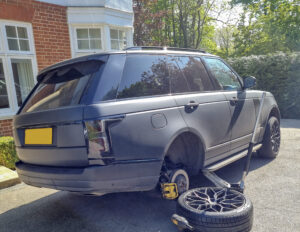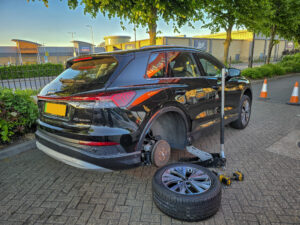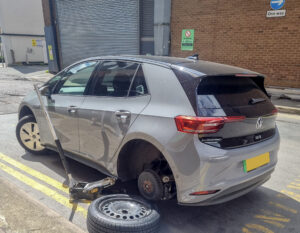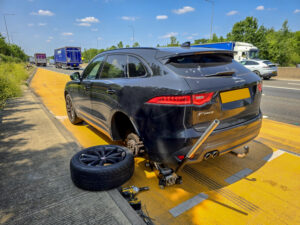
Most drivers can tell you their car’s fuel economy roughly, but ask about tyre pressure and you’ll usually get a shrug.
That’s worth fixing, because pressure affects almost everything about how a car handles, brakes, and wears out its tyres. We cover the wider picture on tyre health in our complete guide to tyre puncture repair, but pressure deserves a proper look on its own.
It’s also one of the few things on a car that genuinely takes less time to check than it does to explain why you haven’t checked it.
What Correct Tyre Pressure Really Means
The correct tyre pressure in the UK isn’t one universal number. It’s specific to your car, your tyre size, and even how loaded the vehicle is.
Get it wrong in either direction and there’s a cost. Too low, and the tyre flexes more than it should, generating heat and wearing the edges faster. Too high, and the middle of the tread wears out while grip suffers across the board.
Both mistakes are easy to make without realising. A tyre can look completely normal while running 20% under its target pressure, since the sidewall design of most modern tyres hides a surprising amount of underinflation from a casual glance.
Fuel economy takes a hit too, though it’s rarely the reason people notice a problem. A car running consistently underinflated tyres can use noticeably more fuel over a year than one kept at the correct pressure. The engine simply has to work harder to overcome the extra rolling resistance.
Where to Find Your Recommended Tyre Pressure
Your recommended tyre pressure is usually printed in two places. Check the sticker inside the driver’s door frame, and the fuel filler cap.
Both list figures for front and rear tyres, often with a separate number for when the car’s fully loaded. Ignore the number on the tyre’s sidewall itself. That’s the maximum the tyre can handle, not what your car needs.
If the sticker’s worn away or missing, most manufacturer websites list the figures by model and year. It’s also worth asking when you next book a service, since most garages have the information to hand and can jot it down for you.
Some cars use a single pressure figure front and rear. Others specify a slightly higher rear pressure for when the car’s carrying passengers or luggage. It’s worth checking both rows on the sticker instead of assuming one number covers all four tyres.
How to Check Tyre Pressure Properly
Checking tyre pressure takes about five minutes for a full set of four, and it’s worth doing when the tyres are cold, ideally before you’ve driven anywhere that morning.
Here’s the process, step by step:
- Find your correct pressure figures on the door sticker or in the handbook before you start.
- Remove the dust cap from the valve and set it somewhere you won’t lose it.
- Press the gauge firmly onto the valve until the hiss stops and you get a steady reading.
- Compare the reading against your target figure, and add or release air as needed.
- Check all four tyres, plus the spare if your car has one, since pressure drops evenly across all of them over time.
- Refit the dust caps once you’re done, since a missing cap lets dirt into the valve over time.
Most petrol stations have a coin-operated or free air pump that does the job. A separate tyre pressure checker at home is cheap and saves a special trip.
Temperature affects the reading too. Pressure rises slightly as tyres warm up through driving, which is why checking cold, before a journey instead of after one, gives the more accurate figure.
Choosing a Tyre Pressure Checker That’s Worth Trusting
A decent tyre pressure checker doesn’t need to be expensive. Digital gauges tend to be easier to read accurately than the older dial or pencil types, especially in poor light.
Cheap gauges can drift out of accuracy over time. If your readings seem consistently odd compared with what a garage pump shows, it’s worth replacing the gauge instead of assuming your tyres are the problem.
What Your Tyre Pressure Warning Light Is Telling You
A tyre pressure warning light means the system has detected a drop below the threshold it’s set to flag, usually a noticeable amount instead of a tiny variation.
It doesn’t tell you which tyre, or by how much, on most cars. It’s a prompt to check manually, not a diagnosis on its own.
Some systems measure pressure directly, through a sensor in each wheel. Others estimate it indirectly, by comparing how fast each wheel is spinning relative to the others. Indirect systems tend to be slower to notice a slow drop, since a small difference in rotation speed takes longer to register as significant.
Either system needs occasional recalibration, particularly after a tyre’s been changed or rotated. If your light behaves oddly straight after a service, that’s often the first thing worth asking about.
The light staying on after you’ve topped up all four tyres usually means one of two things. Either the system needs resetting through the car’s menu, or there’s a slower leak somewhere that topping up hasn’t solved.
The Symptoms of Low Tyre Pressure You Shouldn’t Ignore
Not every car has a warning light, and even those that do can lag behind reality. A few physical signs are worth knowing regardless.
The steering can feel heavier or slightly vague. The car may pull gently to one side. Fuel economy can drop without any obvious explanation, since underinflated tyres create more rolling resistance.
Visually, a tyre that’s noticeably more bulged at the base than the others is usually running low. By the time it’s obvious to the eye, it’s often lost a fair amount of air already.
Handling in the wet is where low pressure shows up most dangerously. An underinflated tyre struggles to clear water from the contact patch as effectively as one at the correct pressure, which increases the risk of aquaplaning at motorway speeds.
Vans and Caravans Need Checking Too
Pressure matters even more once you’re carrying real weight. A van loaded for a job needs different pressure to one running empty, and getting it wrong affects braking distance more than most drivers expect.
Caravans and trailers are frequently the most neglected tyres on the road, simply because they sit unused for weeks between trips. A caravan tyre can lose noticeable pressure over a few months in storage, even with no puncture at all.
Check trailer and caravan tyres before every trip, not just at the start of the season. Pressure loss doesn’t pause just because the van’s parked on the drive.
It’s worth checking the spare on a caravan too, if it carries one. Spares are the tyre everyone forgets, right up until the moment they’re the only one available.
A Case Study From Codicote
A customer in Codicote, who we’re calling Ellie here to protect her privacy, called us convinced she had a puncture. Her steering had felt heavier than usual on the way to work.
We checked all four tyres on arrival. None were punctured, but all four were noticeably under her car’s recommended pressure, likely from a slow, general drop over several months without a check.
We topped up all four to the correct figures from her door sticker and talked her through checking them monthly going forward. She mentioned afterwards that she’d genuinely assumed tyre pressure was something garages dealt with during a service, not something she needed to think about in between.
That assumption is more common than you’d think, and it’s exactly how gradual under-inflation goes unnoticed for months at a time.
A few weeks after the visit, Ellie called back to say she’d started checking pressure herself every fortnight, mostly out of curiosity to see how quickly it dropped. It hadn’t moved much, which is normal. Most of the damage happens when nobody checks at all, not when pressure drifts slowly within a reasonable range.
Get Your Pressure Checked Properly
A five-minute check costs nothing and catches problems long before they become a puncture, a blowout, or an unexpectedly high fuel bill.
If you’re not confident doing it yourself, or you’d rather have someone check your whole car properly, our mobile tyre fitting service covers pressure as standard on every visit.
If something feels off and you’re worried it’s more than pressure, our mobile tyre repair service can rule a puncture in or out properly. For a sense of what a typical visit looks like before you book, our post on what to expect from a mobile tyre fitting service walks through it.
TyreSafe publishes seasonal pressure-check reminders, and the Highway Code’s guidance on vehicle maintenance covers the legal side of keeping your tyres in a roadworthy condition, pressure included.
Prefer to call? Ring us on 07411 448680.